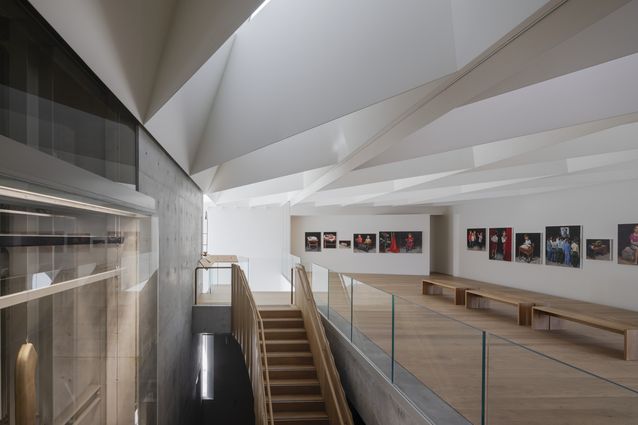
Phoenix Central Park is a gallery and event space in Sydney designed by Durbach Block Jaggers and John Wardle Architects. The performance room, designed by the architects Durbach Block Jaggers, has the shape of a bell with stepped walls formed by curved horizontal wooden slats. The brick facade was an architectural collaboration Attached to the auditorium is a gallery space designed by John Wardle Architects as a stack of irregular boxes made of concrete that was left free as a backdrop for the artworks. Both studios worked together to create the alternately jagged and undulating facade of long facades of light-colored brick that encircle the building. Long light bricks were washed with mortar to look like stone. “The facade was the result of equals engaging in serious architectural back-and-forth,” Camilla Block and Neil Durbach, co-founders of Durbach Block Jaggers, told Dezeen. “Phoenix Central Park is an essay in the collaborative process,” added John Wardle, founder of John Wardle Architects. “Our two practices came together, often with the client in the room and discussed strategies that were both in contrast to and in the orchestration of both practices and the internal strategies used.” The cultural site was commissioned by Australian billionaire Judith Neilson as a place to bring together the visual and performing arts. “One of the intrigues of this commission was the lack of specific details from our client Judith Neilson, they wanted to make the assignment as open as possible,” said Wardle. “This is a private gallery space that sometimes appeals to public programs, this fueled the idea of spaces containing individual works and an audience from one.” Holes from the casting process can be used to hang art. To implement this concept, the gallery space contains a mix of rooms, some designed to display a single work of art in isolation alongside rooms large enough to house entire collections. Concrete floors, which were poured “together” on site, are connected by a wooden staircase with ridges that reflect the warped masonry of the facade. “The basement, ground floor and first floor are made of in-situ concrete, the level of difficulty was extremely high, as the floor plans of this building are located on a narrow inner-city area,” explains Wardle. “The galleries were sculpted from hard walls of solid concrete and soft walls of plaster with a deep background for the attachment of works of art,” he added. “We developed a suspension system that uses the tie-rod holes used in the construction of the precast elements.” Skylights allow soft light into the upper galleries. Skylights allow soft, diffuse life to penetrate the upper galleries, while the floor below remains atmospherically gloomy. Another oculus forms an eye-catcher on the outer wall, with the brickwork surrounding the round window and its smaller, slightly offset twin. Round windows look like they are pressed into the facade. This unique feature is intended to attract the attention of passers-by while also reminding visitors to the gallery of the world outside the walls, the architect said. “We were interested in using brick as a complete surface, a fabric-like curtain that abstracts and approximates the structural properties of the internal elements,” said Wardle. “The huge dimple indicates the weight of the two interlocking windows that affect the fabric of the brick surface.” Curved wood lines the performance room. Photo by Julia CharlesThis sense of drama continues in the performance venue, where Durbach Block Jaggers chose a layout inspired by Elizabethan-era theaters. The stage is designed to be visible from all sides, so that a balcony area with seating is wrapped around the curved walls. There are many different vantage points to see performances. Photo by Martin Mischkulnig “The performance room is a billowing, bell-shaped wooden room, a carved clearing that is located in a silent and enigmatic facade,” said Block and Durbach. “Crossing the threshold is an unexpected leap from the ordinary to a secret room of kept peace.” Elevators between floors are a dramatic red. Photo by Tom Ferguson The light wooden ribs create a distinctive, tactile background that serves both an acoustic and an aesthetic function. These wooden elements were prefabricated in the factory and assembled on site. Outside the theater, the lobbies are dark and atmospheric, interrupted by gold-lined arches and striking red elevators that shine blood-colored light when the doors are opened. Courtyard gardens are planted with succulents. Photo by Tom FergusonPlanters in the courtyard garden have similar irregular outlines that reflect the asymmetrical walls of the venue. The thick edges of the planters also serve as benches, and inside, hardy succulents and cacti are planted on a gravelly surface. Phoenix Central Park has been longlisted for the 2020 Dezeen Awards. John Wardle Architects was founded in 1986 by John Wardle and has offices in Melbourne and Sydney. Wardle won the Australian Institute of Architects gold medal earlier this year. Durbach Block Jaggers was founded by Neil Durbach, Camilia Block and David Jaggers and is based in the town of Potts Point. A previous housing project by the studio is this cliff-top house inspired by a Picasso painting. The photography is by Trevor Mein, unless otherwise stated. Project credits: Architects: Durbach Block Jaggers and John Wardle Architects. John Wardle Architects Team: John Wardle, Stefan Mee, Diego Bekinschtein, Alex Peck, Luca Vezzosi, Adrian Bonaventura, David Ha, Ellen Chen, Andy Wong, Manuel Canestrini, Meron TierneyDurbach Block Jaggers Team: Neil Durbach Camilla Block, David Jaggers , Simon Stead, Anne Kristin Risnes, Deb Hodge, Xiaoxiao Cai, Adam HohProject Leader: Aver, ColliersPlanner: Mersonn StructuralEngineer: TTWCivil Engineer: TTWGeotechnical Engineer: Pells Sullivan MevolvylinkBuilding Engineering Services: Engineer: Marshallkustikustikberscape Fire Engineer: Architectural Consultants: GTAbercape Fire Engineer: Marshallkustik Consultantscape Fire Engineer: Architectallkustikberands, Fire Engineer: GTA Consultants, Fire Engineer : 360ºSignage and signposts: Studio OngaratoBuilding appraiser: Philip Chun & AssociatesAccessibility advisor: Philip Chun & Associates Facade engineers: InhabitLighting Design: BluebottleCustom bricks: Krause Bricks Masonry: F .tti bricklaying Architect Steel construction and art hanging wing doors: TILT; All styled Active MetalOff molded concrete: Hi-FormGallery Roof: ARC roof with ARMA wood source: DinesenHolz and joinery: Top Knot Carpentry and Joinery GRPCeings: Shapeshell with DDIStone Seat: Covered by Hendersons Quarry in Harcourt and processed by Studio 2CLT Performance Space Ceiling: Hess SpecialtyRender: CoverUp Dynamics Brass Basin: Custom HouseBrass Linings: Bronze WorksTile: NashTiling: Debrich Commercial Kitchen: AustmontSpecial Glass: Ozsea; Definitive GlassEmergencies and Exits: Bluelab Design, Australian distributor of ETAP LightingBrass DBJ Hardware: Chant Hardware: Keeler Joinery and upholstery: Infracraft Contractor: Bellevarde Construction; FDC group
[ad_2]