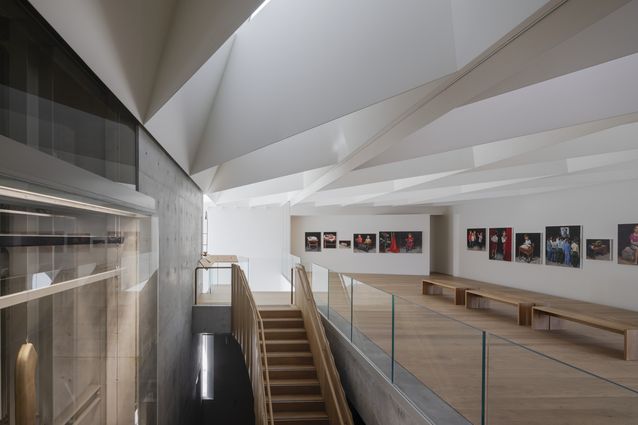
Phoenix Central Park Gallery / John Wardle Architects + Durbach Block Jaggers © Martin Mischkulnig + 29 Share ShareFacebookTwitterPinterestWhatsappMailOrhttps: //www.archdaily.com/947142/phoenix-central-park-gallery-john-wardle-architects-plus-durbach-block-jaggers © Trevor Mein Text description by the architects. The vision of the remarkable art philanthropist Judith Neilson, the building is a partnership of architecture and artistic fields. The rooms are to work together, the visual arts are to be interwoven with the performing arts. Two architects brought the design together: John Wardle Architects designed the gallery in the east wing and Durbach Block Jaggers designed the performance room. The components are centrally connected by an inner courtyard and garden. © Tom Ferguson In principle, both the gallery and the theater must be separated from the outside world in order to control light, humidity, temperature and acoustics. This enabled every architect to explore his own material and form language within his inner world. Because of their function and proximity, the gallery and theater are in constant dialogue. They are connected by a continuous outer skin of masonry that encloses everything – a skin that was designed jointly by both architects, iteratively, with conversations and debates, both rigorous and polite, with disrespect, humor and respect. © Martin Mischkulnig Through this outer surface, the peculiarities of each interior emerge and break out in windows, doors and portals. A defining element is the dialogue between gallery and theater, inside and outside – an exploration of how a building can be two things at the same time, both as well as, so to speak. © Martin Mischkulnig Neither a house museum nor a public gallery, this sequence of gallery rooms choreographs a journey from intimate spaces for the presentation of individual works to spacious areas for the presentation of collections. It is made up of concrete walls carefully crafted on site and consists of a complex stack of different volumes connected by stairs and bridges. Each band acts as an individual framework for the art, but also retains awareness of the ensemble as a whole. © Tom FergusonUnexpected views, natural light will come in from above and stairs with material inventiveness attract the curious. A field of skylights over a low open space offers a dramatic relief from the darker atmosphere of its lower area. Angular and sharp, they reflect and filter the light into a soft, “fuzzy” glow. © Martin MischkulnigGround plan of the floor plan © Martin MischkulnigThe brick surface facing the street was pressed inwards to form a circular depression with a large oculus in the center Window and a smaller offset companion window. Inside, the studded wall draws attention to this figural opening to the world beyond the gallery. © Gavin Green The performance space is a unique bell-shaped clearing made up of stepped and contoured wooden ribs embedded in a fabric of lobbies and circulation. As in an Elizabethan theater, the action takes place in a circle, seen from many vantage points. A protruding balcony loops into the volume and creates an alternative stage or viewing box. The circulation takes place directly or via a graceful series of landings, which are scaled to stop the movement and invite the overview. © Julia Charles The oversized golden window allows glimpses and light from the street into an otherwise dark room. The theater is lined with wood that is manufactured in the factory from digital templates and assembled on site. © Martin Mischkulnig The jointly written project was led by an open discussion between the two architectural offices. The project is perhaps a more compelling proposition for each other’s input and insight. This idea seems to reflect the primary intention of Phoenix Central Park: to be an artistic center in which the visual and performing arts are in constant dialogue with one another. © Martin Mischkulnig
[ad_2]