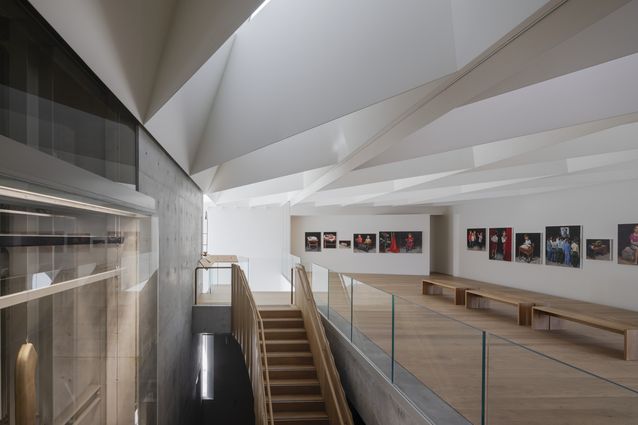
click to enlarge Richard Levinson’s Sara Brodsky’s ring will be on view until October 9th. Clutch Photos It’s been more than 100 years since a police lieutenant removed a watch and ring from the charred hand of Sarah Brodsky, a 21-year-old who died in The Fire at the Triangle Shirtwaist Factory in New York City. More than 140 people, mostly young immigrant women, were killed in the famous 1911 fire that resulted in some workers falling to their deaths, similar to those who jumped from the Twin Towers on September 11th. Despite the horror of what happened, artist Richard Levinson was inspired by the tragedy after a poignant encounter with Brodsky’s ring, which was given to her fiancé after the fire. Today the ring, which Levinson describes as a “mythical object”, belongs to a good friend, the granddaughter of a woman who married Brodsky’s fiancé years after losing his first love in the flames. “The ring,” he says, “sees through the love that carries over through the generations.” Of course, it is common for jewelry to be passed on from one family member to another. But here the ring took a detour, which gives the object even more emotional power. In fact, Brodsky’s fiancée married twice in the years following her death. His first wife died of tuberculosis and both women knew the history of the ring they wore. “The ring was given out of love and respect for past love, even if it was looking forward,” says Levinson. Related Stories I Support Local Community Journalism Support the independent voice of Phoenix and help keep the future of the New Times clear. In 2016, Levinson began a new work that is rooted in the journey of the ring. Now the installation Sarah Brodsky’s Ring will be shown for the first time in the Bentley Gallery. Upon entering a cave-like exhibition space with exposed wooden beams and concrete floors, visitors to the gallery see large-format acrylic and graphite pictures on crumpled linen with raw edges, a material that refers to the fabric manufacturers who were used to make the shirt-waistband buttons and style blouses of that time. A borderline image of Brodsky’s face appears in the center of a large piece of art that people see on the left after entering the main gallery. Installed so that the underside of the fabric can gently sway and detach from the wall, it appears to signal Brodsky’s ghostly presence, as if watching the journey and impact of the ring unfold before her. Elsewhere, the artist has created other, sometimes barely visible faces that refer not only to the deadly fire, but also to his own encounters with loss. Click to enlarge Installation view of Sarah Brodsky’s Ring in the Bentley Gallery. Clutch Photos Levinson spent decades as a pulmonologist and critical care practitioner, an experience which he attributes to a significant influence on his larger work. The form and materiality of several works stimulate reflection on breathing hoses, radiological images and the reality that most fire victims die from smoke inhalation and not from flames. It’s powerful symbolism, especially in the age of COVID-19. A large cityscape that is hung near the center of the gallery anchors the installation. Predominantly shown in black on two pieces of transparent mesh hanging back to back, it invites the viewer to consider the wider context of the factory fire and the way in which city life can both hinder and promote human connections. For another work, Levinson reproduces elevator numbers, knowing that several women died trying to escape through an elevator shaft. Others died trying to climb down a fire escape, which Levinson conveys with a mixed-media sculpture with a pair of ladders. Everywhere in the gallery the viewer sees rings made of thin wire, which often protrude into the air as if they were floating through the room. There are many circles that indicate both the physical ring and the circularity of human existence. As a doctor, Levinson often observed the importance that certain objects had on his patients and their families. In the intensive care units of hospitals, for example, he often saw people bringing in items related to the history and interests of patients, from children’s toys to current golf trophies. “People put emotional power into these objects,” he says. “They conjure up the best memories you have.” As viewers explore Sarah Brodsky’s Ring at the Bentley Gallery, viewers encounter the story of a deadly fire, a found object, and the way love lives amid loss. But they also experience the respite to look at their own relationships with objects, memories, and losses at a time of personal and shared history shaped by the devastating effects of pandemic life. Sarah Brodsky’s ring continues at Bentley Gallery, 215 East Grant Street through October 9th.
[ad_2]